



















Inside the article
Request a product demo
Get a demo and clarify your doubts about our software.
Key Takeaways
- Ride-hailing apps in 2026 are a big opportunity, but success depends on smart planning, not just coding.
- You can build a ride-hailing app using native, cross-platform, or white-label options based on budget and speed.
- Core features like live GPS, payments, driver apps, and admin control are non-negotiable.
- Building from scratch costs more but gives full control, while white-label apps help you launch fast.
- Long-term growth depends on updates, support, legal compliance, and city-by-city scaling.
In recent years, ride-hailing apps have transformed urban transport, providing users with convenience. As we near 2026, the market is valued at $184.49 billion, with growing demand creating opportunities for entrepreneurs.
This blog discusses ride-hailing app and ride-sharing app development, including key features and trends essential for launching or updating a service.
What is Ride Hailing App Development?
Ride-hailing app development or ride-sharing app development focuses on creating user-friendly apps that connect riders with nearby drivers in real time.
This involves designing the user interface, implementing GPS tracking, integrating payment gateways, and adding features for both riders and drivers.
Whether launching a startup or upgrading a taxi service, these apps can enhance travel experiences for customers.
Types of Ride-Hailing App Development
Ride-hailing apps can be developed in different ways based on cost of developing the app, timeline, and performance needs, each offering unique strengths like performance, development ease, or broader reach.
Native App Development
Native app development involves creating two separate apps: one for iOS in Swift and another for Android in Kotlin.
This method ensures faster load times, precise GPS, smoother maps, and better real-time updates.
Costs range from $90,000 to $180,000 due to separate codebases and longer development times.
It's ideal for high-traffic apps, multi-city expansion, and long-term scaling.
Pros
- Optimized performance with faster load times and seamless tracking.
- Accurate GPS and location updates.
- Full access to device features like notifications and the camera.
- Enhanced stability for high-traffic apps.
Cons
- Higher development cost since iOS and Android apps are built separately
- Longer development time compared to other approaches
- Requires separate maintenance and updates for each platform
Common / Cross-platform App Development
Cross-platform app development for ride-hailing apps uses a single codebase (like React Native or Flutter) for both iOS and Android.
Key features include GPS tracking, live maps, ride requests, and push notifications, offering a faster and more cost-effective solution than native apps.
Costs typically range from $50,000 to $100,000, making it suitable for startups and MVPs.
Pros
- Lower development costs than native apps
- Faster time to market with a shared codebase
- Easier maintenance and updates
- Good performance for ride-hailing use cases
Cons
- Lower performance compared to native apps
- Limited access to advanced device features
- May need native code for complex functions
- Performance tuning can be challenging for large apps
Hybrid / Web App Development
Hybrid app development for ride-hailing utilizes web technologies like HTML, CSS, and JavaScript, wrapped in a mobile container (e.g., Ionic, Cordova) or accessed via a browser.
This method enables quicker and cheaper development of features like ride booking, fare estimates, and notifications, though it comes with performance trade-offs.
Pros
- Lowest development cost among all approaches
- Very fast to build and launch
- One codebase works across mobile and web
- Easy updates without app store approvals (for web apps)
Cons
- Slower performance, especially for live maps and GPS tracking
- Limited access to native device features
- Not ideal for large-scale or real-time ride-hailing apps
Ways to Develop Your Ride-Hailing App
There's more than one way to access ride-sharing app development services. From independent freelancers to dedicated agencies or a mix of both, each option comes with different trade-offs in cost, speed, and quality.
Hire Freelancers
This option is great for solo entrepreneurs or early-stage startups on a tight budget. You hire individual developers and manage the project yourself, offering flexibility and lower costs, but you'll need to oversee coordination, timelines, and quality control.
Where to find them: Upwork, Freelancer, Toptal, LinkedIn, GitHub
Pros
- Lower cost compared to agencies
- Flexible hiring
- Good option for MVPs or early-stage ideas
Cons
- Quality depends heavily on individual skill level
- Risk of delays if a freelancer drops out mid-project
- Harder to maintain long-term support
Small App Development Agency
Ridesharing app development services offered by a small agency handles the entire app, from design to development and testing. This is a good choice if you want less hands-on management and a structured process. It costs more than freelancers but usually delivers better consistency and accountability.
Where to find them: Clutch, GoodFirms, Google, LinkedIn company pages, Referrals from founders or startups
Pros
- Better structure and accountability
- Faster development with a dedicated team
- Clear timelines and deliverables
- Less hands-on management for you
Cons
- Higher cost than freelancers
- Less flexibility to make frequent scope changes
- Quality varies between agencies, so vetting matters
Buying a White-Label Solution
Buying a white-label ride-hailing app means you're getting a fully developed and tested product.
The basic framework is already there; all you need to do is customize it with your logo, colors, and settings. This option is popular with entrepreneurs who want to launch quickly without having to build everything from scratch.
Pros
- Launch quickly
- Reduced development costs due to pre-handled technical groundwork
- Easier to budget with usually fixed upfront pricing
Cons
- Performance and scalability depend on the quality of the original product's design
- Dependence on the vendor for updates, fixes, and long-term support
- Risk of being stuck if the vendor stops maintaining the product
Cost of buying a white-label solution
In the U.S. market, white-label ride-hailing solutions typically range from $15,000 to $40,000. And RentALLScript gives the same product with key features + AI features, with pricing ranging from $4000 to $6000 with no hidden fees.
Pricing varies by features, platforms, and licensing. Some vendors charge a one-time fee, while others use monthly subscriptions, per-driver fees, or revenue-sharing. Additional costs often include hosting, third-party APIs, and app store fees.
See how RentALLScript ride-hailing solutions compare on pricing and features.
👉 Want to see how it works? Explore the RadicalStart Uber clone.
How to build a Ride-Hailing App from Scratch?
Building a ride-hailing app from scratch is a structured process that includes pre-development, development, and post-development stages.
Each phase focuses on planning, building, testing, launching, and optimizing the app to ensure it is scalable, reliable, and capable of handling real-time bookings, payments, and future growth.
Pre-Development Phase
The pre-development phase acts as the foundation for your ride-hailing app by validating demand, defining users, and setting clear technical and business boundaries. Decisions made at this stage help avoid costly rework, unnecessary features, and legal issues once development begins.
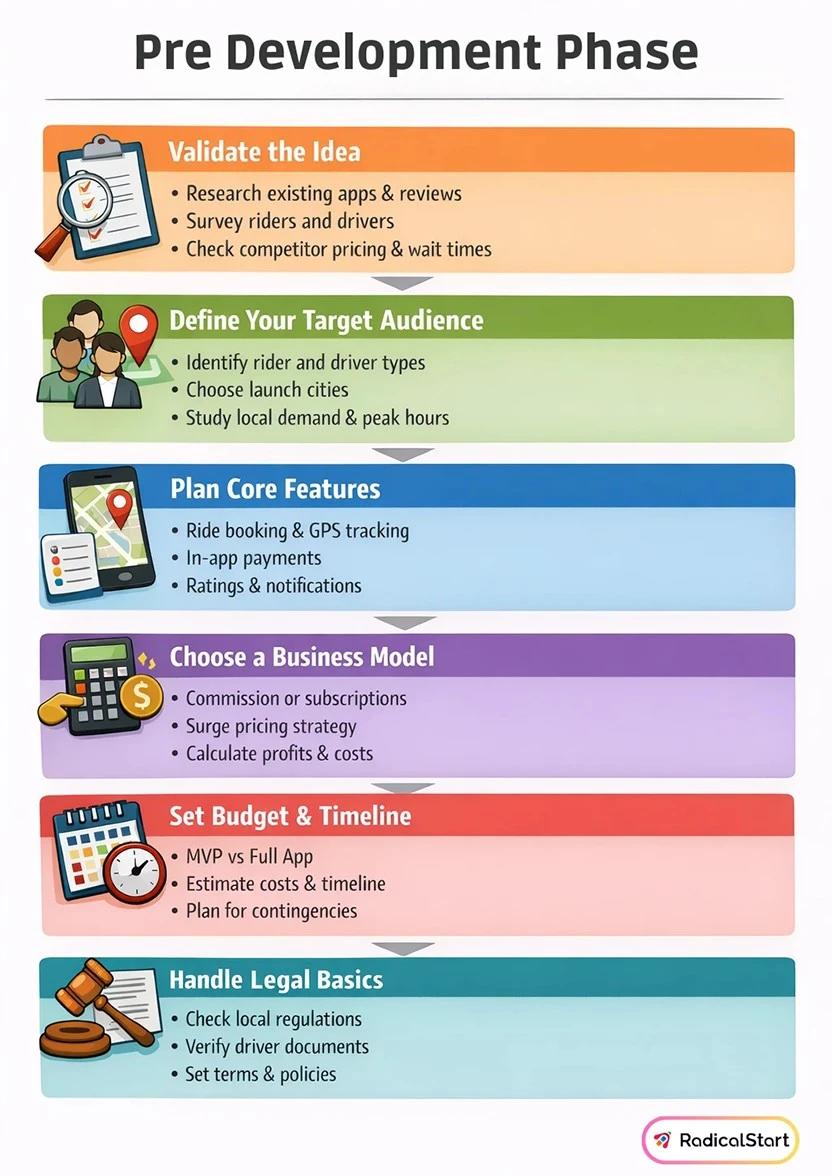
Step 1: Validate the idea
Check existing ride-sharing apps in your city, read user reviews for complaints, and conduct surveys with Google Forms or talk to drivers and riders to identify their needs and gaps.
Step 2: Define your target audience
Are you targeting daily commuters, airport travelers, or local deliveries?
Pick one or two cities to start with and study their ride demand, peak hours, and driver availability.
- Identify rider types (daily commuters, airport travelers, local trips)
- Decide driver type (full-time, part-time, fleet owners)
- Choose launch cities based on population and local demand
Step 3: Plan core features
List the must-have features like ride booking, live GPS tracking, in-app payments, ratings, and notifications. Keep it focused to avoid overbuilding early on.
Step 4: Choose a business model
Most ride-hailing apps take a commission per ride. Others use driver subscriptions or dynamic surge pricing. Run basic calculations in a spreadsheet to see if the numbers work.
Step 5: Set budget and timeline
Estimate how much the app will cost to build and how long it'll take. This keeps expectations realistic from day one.
- Decide MVP vs full-featured app
- Estimate costs for design, development, testing, and launch
- Plan a launch timeline (usually 3–6 months)
- Keep a buffer for unexpected changes
Step 6: Handle legal basics
Before you start building, make sure the app can legally operate.
- Research local transport and taxi regulations
- Define driver verification rules (license, ID, vehicle documents)
- Set terms, privacy policy, and refund rules
- Ensure payment gateways follow security standards
Check out our guide on 👉 “How to Write a Writing a Business Plan for an Online Taxi Business.”
Development Phase
This phase turns the approved plan into a real, working ride-hailing app. Everything is done in a set order, so nothing important gets missed.
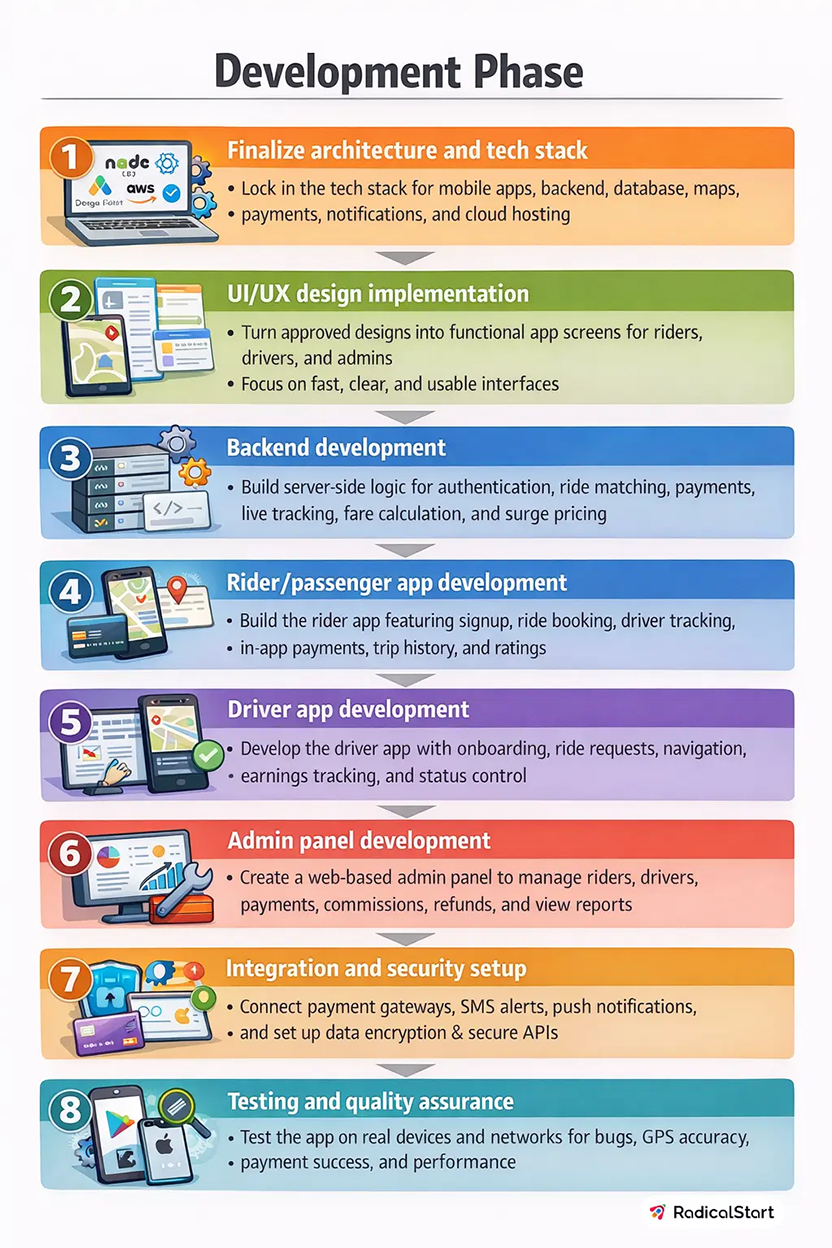
Step 1: Finalize architecture and tech stack
Before any coding starts, the technical foundation is locked in. This makes sure the app can handle real-time tracking, heavy traffic, and future growth.
- Mobile apps: Native: Swift (iOS), Kotlin (Android) | Cross-platform: Flutter or React Native
- Backend: Node.js, Django, or Laravel
- Database: PostgreSQL or MongoDB
- Maps & location: Google Maps or Mapbox
- Payments: Stripe, Razorpay, or PayPal
- Notifications: Firebase Cloud Messaging (FCM)
- Cloud hosting: AWS, Google Cloud, or Azure
Step 2: UI/UX design implementation
Approved designs are developed into app screens, including rider booking, tracking, payment screens, driver request and navigation screens, and admin dashboards. The focus is on fast loading, clear actions, and minimizing taps.
Step 3: Backend development
The backend serves as the app's brain, managing user authentication, ride matching, fare calculation, GPS updates, and payment processing. APIs enable smooth communication between the mobile apps and the server.
Step 4: Rider/passenger app development
The rider app is built on features. Smooth performance and accurate map updates are critical at this stage.
Key features:
- Real-time GPS tracking with accurate ETAs
- Multiple payment options (cards, wallets, Apple Pay / Google Pay)
- Upfront pricing and fare breakdown
- Ride history and receipts
- In-app support and driver ratings
Step 5: Driver app development
The driver app is focused on reliability and background tracking.
Key features:
- Easy onboarding and document verification
- One-tap ride acceptance
- Turn-by-turn navigation
- Earnings dashboard and payout tracking
- Background GPS tracking without battery drain
Step 6: Admin panel development
The admin panel gives full control over the business. It's used to manage riders, drivers, and vehicles, monitor live rides, handle payments, commissions, and refunds, and view reports and analytics.
This panel is usually web-based.
Key Features:
- Live ride monitoring
- Dynamic pricing and surge controls
- Driver performance tracking
- City-wise pricing and rules
- Reports for revenue, taxes, and payouts
Curious about how the Rider app, Driver app, and Admin panel work together?
View the demo below.
Curious About Our Ride-Hailing App?
Take a live tour of the Rider App, Driver App, and Admin Panel and see every feature in action.
Step 7: Integration and security setup
All third-party services are connected at this stage, including payment gateways, SMS and email alerts, and push notifications. Data encryption and secure APIs are set up to protect user information and payments.
Step 8: Testing and quality assurance
Testing is done on real devices and under different network conditions. Booking flows, GPS accuracy, payment success and failure cases, and peak-load performance are all checked. Bugs, crashes, and slow screens are fixed here.
Step 9: App store launch
After final approval, the apps are published on the Play Store and App Store. Server monitoring is enabled, analytics tools are connected, and the app is ready for real users.
Bonus: Competitive features to add to your ride-sharing app
- Referral programs
- Promo codes and discounts
- Cancellation fees logic
- Safety features (SOS, trip sharing)
- Analytics for demand forecasting
Post-Development
Once the app is live, the real work starts. Post-development is about keeping the app running smoothly, growing users, and staying compliant with U.S. laws and taxes.
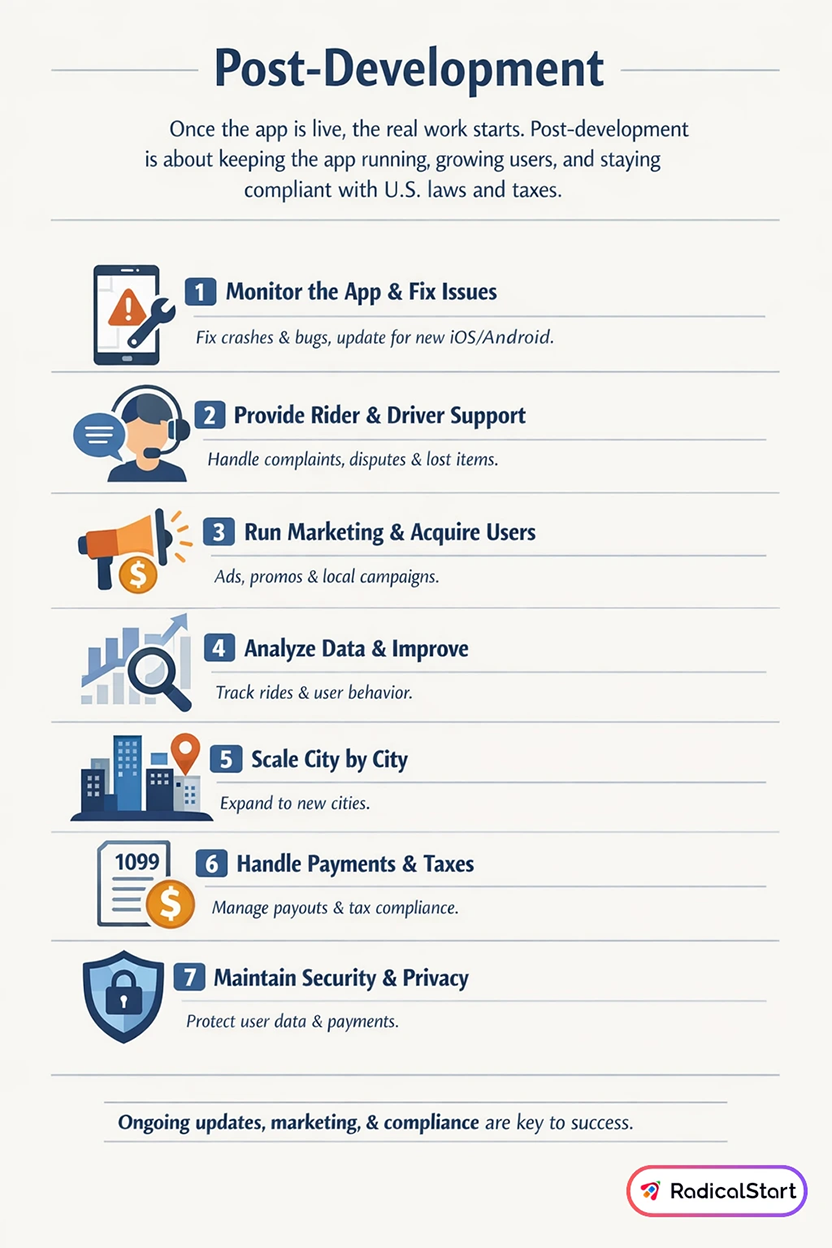
1. Monitor the app and fix issues
After launch, the app may face crashes, slow screens, and bugs. Regular updates are essential to fix issues, enhance performance, and ensure stability on new iOS and Android versions.
2. Provide rider and driver support
Support becomes critical in the U.S. market, where users expect fast responses. This includes handling ride cancellations, payment disputes, driver complaints, and lost-item reports.
Many apps use in-app chat, email, or call support to manage support.
3. Run marketing and user acquisition
To grow in U.S. cities, you'll need consistent marketing. This usually includes Google Ads, Meta ads, Apple Search Ads, social media ads, referral programs, promo codes, and first-ride discounts.
Local city-based campaigns work better than nationwide ads in the early stage to get.
👉 Also Read the full guide to get your first 1000 taxi app users.
4. Analyze data and improve the app
Track ride completion rates, peak hours, user drop-offs, and driver availability using tools like Google Analytics for event tracking, Tableau for visualization, and Mixpanel or Amplitude for user behavior analysis.
Use Python (Pandas/Matplotlib) for deeper insights.
This data helps improve pricing, reduce wait times, and optimize city-wise expansion.
5. Scale city by city
Expansion in the U.S. typically happens one city at a time. This means onboarding local drivers, adjusting pricing for each city, and handling region-specific regulations. Scaling too fast without local readiness may cause service issues.
6. Handle payments, taxes, and compliance
U.S. tax and compliance rules matter a lot after launch. Driver payouts must be tracked properly, and income reporting needs to follow IRS guidelines.
Many ride-hailing platforms issue 1099 forms to drivers, manage sales tax where applicable, and comply with state and city-level transport regulations.
7. Maintain security and data protection
User data and payment information must be protected through regular security updates, encrypted payments, and compliance with U.S. data protection standards to prevent breaches and build trust.
Ignoring post-development steps is a major reason ride-hailing apps fail; successful apps prioritize updates, marketing, local compliance, and support.
Cost of Developing from Scratch
Developing a ride-hailing app in the U.S. typically costs $70,000 to $150,000+, depending on the platform (iOS, Android, or both) and features.
This usually includes rider and driver apps, an admin panel, backend systems, payment integration, and testing. Ongoing costs for cloud hosting, map APIs, and updates are extra.
Maintenance and Scaling
After launch, the app needs ongoing maintenance, such as bug fixes, updates for new iOS and Android versions, and performance improvements based on user feedback.
As the app grows, it requires user support, expansion to new cities, server load management, and compliance with U.S. regulations.
While apps built from scratch can scale reliably, they need continuous technical and financial investment.
Top Ride-Sharing App Development Companies
1. RentALLScript
RentALLScript is a US-based product development company, specializing in building ride-hailing apps with a focus on clean architecture and scalability with open pricing.
Founders who choose RentALLScript enjoy 100% source code ownership and are able to launch in 7 days. Their solutions include AI features like smart translation, along with ongoing tech support.
2. Apptunix
Apptunix is a mobile app development company specializing in custom ride-hailing and mobility solutions for startups and enterprises.
Their ride-sharing apps include AI-powered dispatch, real-time ride tracking, driver management, and scalable architecture, making them a strong choice for businesses looking to build modern transportation platforms.
3. ScienceSoft
ScienceSoft develops enterprise-grade ride-hailing and mobility solutions for startups and established businesses.
Their solutions include automated dispatch, fleet management, real-time ride tracking, and scalable architecture, helping organizations build efficient and reliable transportation platforms.
4. Hyperlink InfoSystem
Hyperlink InfoSystem is a software development company that builds custom ride-sharing and transportation applications for businesses worldwide.
Their solutions include GPS-based ride tracking, secure payment integration, ride scheduling, and cross-platform development, making them suitable for startups and enterprises seeking scalable mobility solutions.
5. Suffescom Solutions
Suffescom Solutions provides ride-hailing app development with support for features such as referrals, promo codes, and analytics.
They're often chosen by startups that want a balance between speed, customization, and cost.
Future Trends in Ride-Hailing App Development
Ride-hailing apps are evolving fast, driven by new tech, changing rider expectations, and regulations. The focus is shifting from just booking rides to creating smarter, safer, and sustainable mobility platforms.
AI & Machine Learning
AI and machine learning are becoming essential for modern ride-hailing apps. They help platforms make smarter, real-time decisions rather than relying on fixed rules.
ML models are used for matching drivers with riders and repositioning vehicles. This ensures drivers are assigned and moved to areas where demand is expected.
Mobility-as-a-Service (MaaS)
Mobility-as-a-Service (MaaS) combines ride-hailing, public transport, and shared mobility into a single digital platform, allowing users to plan, book, and pay for their entire trip in one app.
Ride-hailing is essential for MaaS, particularly for addressing gaps in public transport for first-mile and last-mile travel. However, challenges remain, such as scalability and data integration.
EV Taxis & Sustainability
Electric vehicles are becoming a major focus in ride-hailing, especially in the U.S., where reducing transportation emissions is a priority.
Research shows that ride-hailing vehicles are high-mileage and heavily used.
However, EV adoption isn't easy. High upfront costs for EVs, limited access to home charging, and uneven public charging stations are still significant barriers for drivers.
This makes ride-hailing apps focused on EVs a key part of the future of urban mobility.
Women-Only and Corporate Apps
Niche ride-hailing apps are emerging, including women-only platforms that prioritize safety with features like verified drivers and emergency alerts.
Corporate ride-hailing apps are gaining traction in the U.S., offering controlled billing and travel tracking to meet safety and business needs.
Autonomous Vehicles & Smart Routing
Autonomous vehicles are expected to enter ride-hailing gradually, not all at once. Research shows that the near future will likely involve mixed fleets, where self-driving cars operate alongside human drivers.
Ride-hailing platforms will control autonomous vehicles directly, while human-driven cars continue to work independently.
Conclusion
Developing a ride-hailing app in 2026 involves creating a scalable and reliable platform. Factors like development approach, features, and planning are crucial for post-launch performance.
With trends like AI, electric vehicles, and smarter routing influencing the industry, focusing on strong foundations and growth is a must in a competitive market.
Request a product demo
Get a demo and clarify your doubts about our software.
FAQs
The cost of developing a ride-hailing app or an app like Uber ranges from $15,000 to $40,000 for a white-label solution, and from $70,000 to over $150,000 for a fully custom-built app in the U.S.
The timeline varies based on complexity. Simple apps can launch in 1 to 2 months, while custom apps usually take 3 to 6 months or more.
A common and reliable tech stack includes Swift (iOS) and Kotlin (Android) for native apps, or Flutter / React Native for cross-platform builds.
Backends are often built with Node.js, Django, or Laravel, databases like PostgreSQL or MongoDB, maps using Google Maps or Mapbox, and cloud hosting on AWS or Google Cloud.
Yes, you can. You can build one from scratch, buy a white-label solution, or hire freelancers or an agency, depending on your budget and goals.
Many founders start small with an MVP, test the market, and then invest in custom development as they grow. The key is planning for scalability from day one.