



















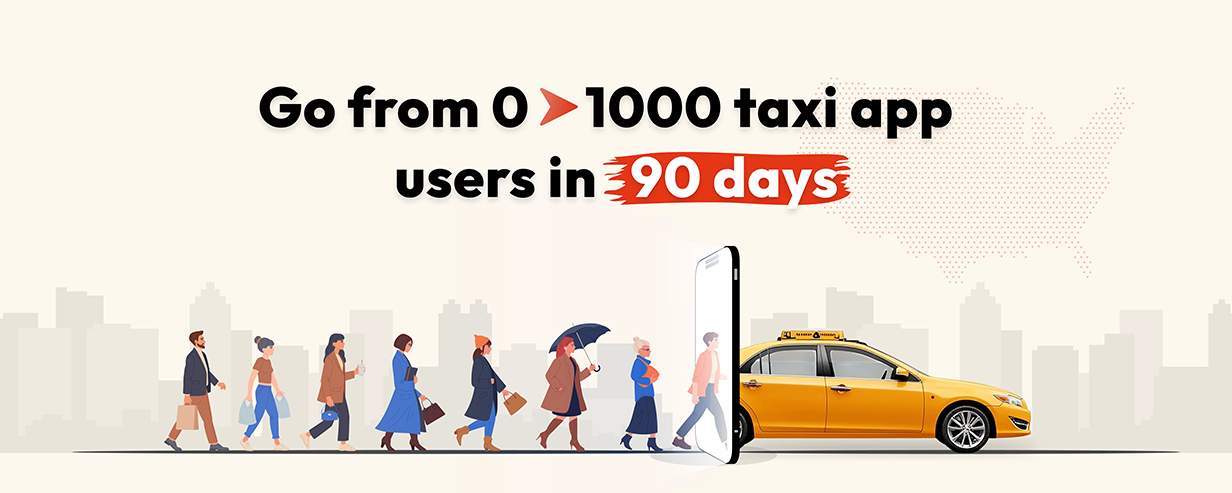
Inside the article
Request a product demo
Get a demo and clarify your doubts about our software.
Key Takeaways
- Aim for fast pickup times (under 5-10 minutes), so people trust the app and keep it.
- A strong early goal is 1,000 completed rides, not 1,000 downloads.
- Launch in a 3 to 5-square-mile area (campus, nightlife, transit hub) to keep wait times low.
- In the first month, pay drivers to stay online in your zone so riders always see cars.
- Upfront pricing, live tracking, multiple payments, scheduling, and SOS tools keep riders loyal.
- After 1,000 users, grow to nearby areas only, keep cars close, and protect pickup times.
- Phase out hourly guarantees, use surge pricing.
- Add B2B accounts for steadier volume. Hotels and local companies can bring repeat rides and easier planning.
Introduction
Ever heard of the “Myth of Sisyphus”? Yeah, that meme where the guy pushes a giant rock up a hill, only to watch it roll back down every single time.

Starting a taxi booking app feels exactly like that. You face a challenge right away. You need riders to attract drivers, but you need drivers to attract riders. It is a constant struggle to keep the rock moving.
This guide helps you stop that rock from rolling back down. If you own a fleet, run a startup, or have just built a new ride-booking app, this post is for you. We skip the complicated theories and focus on real action.
In this blog, we explain why "Reliability" matters more than your total number of users, outline a simple 90-day plan to get your first 1,000 active users, and share easy marketing tricks that big companies like Uber used when they started.
What is "Reliability," and why does it matter?
In Silicon Valley, experts like Andrew Chen (a renowned growth expert at Andreessen Horowitz) call this concept Liquidity. In the taxi business, we call it Reliability.
It answers one simple question: When a customer opens your app, can they find a ride in less than 5 minutes?
This matters because trust breaks easily. If your first 50 users open your app and see "No Cars Available" or a 20-minute wait time, they will delete your app. They won't come back.
Why you need Reliability first:
- Users stay: They keep the app because they know it works.
- Free marketing: Happy users tell their friends (Word of Mouth).
- Happy drivers: Drivers earn money constantly, so they don't leave you for a competitor.
Key Takeaway: Your goal isn't just to get 1,000 downloads. Your goal is to complete 1,000 rides.
How to get your first 1,000 users?
Follow this 90-day roadmap to move from "launched" to "growing."
Step 1: Pick one small neighbourhood (Days 1-30)
Don't launch in the whole city. This is the single biggest mistake new founders make. If you spread 50 drivers across a huge city like New York or London, your wait times will be 20+ minutes.
Instead, create a "Geo-Fence."
Pick one tiny ecosystem. This could be a university campus, a busy nightlife district, or a central transit hub.
- Draw a line: Pick a small circle on the map (about 3-5 square miles).
- Focus your ads: Using Facebook or Google Ads, target only the people physically located inside that circle.
- Result: Even with just 20 drivers, you can offer 3-minute pickup times because all your cars are circulating in a tight loop.
"It's better to have 100 people who love you than a million people who just sort of like you."
- Paul Graham (Founder of Y Combinator)
Step 2: Pay drivers to wait (Days 1-30)
You cannot get riders without drivers. In the first month, you must view driver payments as a marketing expense, not a salary.
When Uber launched in Seattle, they didn't just hope drivers would show up. They paid them to be there. You need to do the same.
- The guarantee: Tell drivers: "If you stay online in this specific zone between 5 PM and 9 PM, we guarantee you will earn $15/hour."
- Why this works: Drivers feel safe because they earn money no matter what. Riders feel safe because they see cars on the map.
Step 3: Let your users find new users (Days 31-60)
Once your app works in your zone, leverage your "Users" to grow.
“Referred customers have a 16% higher lifetime value than non-referred customers. Those who come to a business through referrals tend to generate more referral revenue over time compared to customers acquired through other means.”
Reference Invesp
- The offer: Give the rider a discount (like $5 off) if they invite a friend. Give the friend a reward ($5 credit) too.
- Make it easy: Put the "Invite a Friend" button right on the main menu. Ask them to invite friends right after they rate a ride 5 stars.
- The math: If 100 people invite just 2 friends each, you suddenly have 300 users without paying for ads.
Step 4: Get physical with "Guerrilla Marketing" (Days 61-90)
Online ads cost a lot of money. In the beginning, real-world marketing builds trust faster. Since you are targeting a local area (Step 1), physical ads work best.
- The "Designated driver" partnership: Go to the busiest hospitals in your neighbourhood. Offer the discharge nurse a stack of promo cards. Tell them: "If a patient is medically cleared but stuck occupying a bed just waiting for a ride, give them this card for a free ride home." The hospital frees up a valuable bed immediately, the patient gets to rest in their own home, and you get a user for life.
- Street teams: Hire students to hand out cards at train stations during rush hour.
- Moving billboards: Wrap your drivers' cars with your logo. It builds brand recognition in the neighbourhood.
5 Features that make riders love your app
Marketing gets people to download the app. But features keep them there. If your app is confusing or hard to use, they will switch to a competitor. To keep your retention rates high, ensure that these key features of a taxi app are included.
- Upfront pricing (Fare estimates): Nobody likes surprises. Show the estimated cost before the user books the ride. When customers know exactly what they will pay, they feel comfortable hitting the "Book Now" button.
- Live tracking: Waiting in the dark creates anxiety. Your app must show the car moving on the map in real time. This lets the rider know exactly when to step outside.
- Multiple payment options: Don't lose a customer because they don't have cash. Offer flexibility. Your app should accept credit cards, digital wallets, and cash. The smoother the payment, the happier the rider.
- Ride scheduling: Some trips need planning, like early morning airport runs. Allow users to book a ride for a future date and time. This feature steals customers from traditional taxi dispatchers who rely on phone calls.
- SOS and safety tools: Safety is the number one concern for riders today. Include an SOS button that instantly alerts emergency contacts. Let users "Share Trip Status" so their friends or family can track their ride live.
Wait! You know the strategy, but do you have the app?
You now have a solid plan to get 1,000 users. But you can't get users if you don't have a platform for them to use.
Building an Uber clone from scratch is expensive and takes months. You don't have time to write code while your competitors take your customers.
You need a ready-made taxi booking solution.
We at RadicalStart specialize in taxi booking app development, offering solutions like a fully customizable Uber Clone. We don't just give you code; we give you a business in a box. Our solution includes:
- Rider app (App like Uber/Lyft)
- Driver app for your fleet.
- Admin panel to track every ride and payment.
Don't push the rock up the hill by building your own software. Let us handle the tech so you can focus on getting those 1,000 users.
What happens after 1,000 users? (Scaling up)
Congratulations! You hit your milestone. You have 1,000 active users and a stable fleet of drivers. But the game changes now. You are no longer pushing a rock up a hill; now you are steering a moving car.
If you stop moving, you lose momentum. Here is how to shift gears from "Survival Mode" to "Growth Mode."
1. The "Ink Blot" expansion strategy
Don't rush to unlock the entire city the day you hit 1,000 users. Continue to be disciplined.
Think of your service area like a drop of ink on a paper map. It starts as a small dot (your initial Geo-fence). Now, let that dot bleed outward slightly.
- Look at your data: Check your Admin Panel. Where are people opening the app outside your current zone?
- Expand to adjacent neighborhoods: If your first zone was the University, your next zone should be the popular student housing blocks next to the University.
- Don't leapfrog: don't open a zone 10 miles away. Keep your cars close together to maintain low pickup times.
2. Shift focus to "Unit economics."
In Step 2 of the launch plan, we told you to pay drivers to wait. You burned cash to build trust. Now that you have 1,000 users, you must stop the "burn."
You have enough ride volume now that drivers can earn money from actual fares, not just your hourly guarantees.
- Reduce the subsidies: Slowly remove the hourly guarantee.
- Introduce "Surge Pricing": If demand is high on Friday nights, increase the price slightly. This attracts more drivers naturally without you paying them out of your own pocket.
- Goal: Ensure you make a profit on every ride.
3. Target B2B (Corporate accounts)
Getting 1,000 individual users is great. Getting 5 corporate partners is better.
Business travelers spend more money and take longer trips (like airport runs).
- Approach hotels: Ask the concierge to book rides for guests using your admin panel (Web Dispatch).
- Approach local companies: Offer them a monthly invoice system so they can book rides for their employees without using credit cards every time.
- Why this wins: These rides are often pre-scheduled, which helps you manage your driver supply efficiently.
Tips and reminders
This startup phase is stressful. Keep these three simple tips in mind so you don't waste money:
The startup phase is cash-poor. Keep these tips in mind to stretch your budget:
- Master ASO (App Store Optimization): Don't just name your app "TaxiApp." Name it "TaxiApp: [City Name] Ride Service." This helps you rank for local searches when tourists type "Taxi in [City]" into the App Store.
- Fix mistakes fast: It costs 5 times more to acquire a new customer than to retain an existing one. If a driver cancels on a user, your system should automatically email them a discount code for their next ride. Apologies must be instant.
- Watch your unit economics: If you spend $10 in ads to get a user, but they only spend $5 on your app, you are bleeding money. Ensure your "Lifetime Value" (LTV) is higher than your "Customer Acquisition Cost" (CAC).
Closing
You don't need to shout the loudest to get your first 1,000 users. You just need to be the most reliable option in one specific spot.
Start small in one neighbourhood, make sure your drivers are ready, and use your happy customers to find new ones. Remember, even the biggest ride-sharing app, Uber, started with just a few black cars in San Francisco. Push the rock up the hill once, secure it with reliable service, and it will stay there.
Read Uber Business Model Explained: How Does Uber Make Money?
Are you ready to build your taxi business?
A good strategy needs good software. Book a free demo of our ready-made taxi booking app to see how we can help you launch fast. Built in months
Request a product demo
Get a demo and clarify your doubts about our software.